

42% of Americans Are Considering Moving Abroad. Most of Them Are Asking the Wrong Question.
Read this before you book anything.

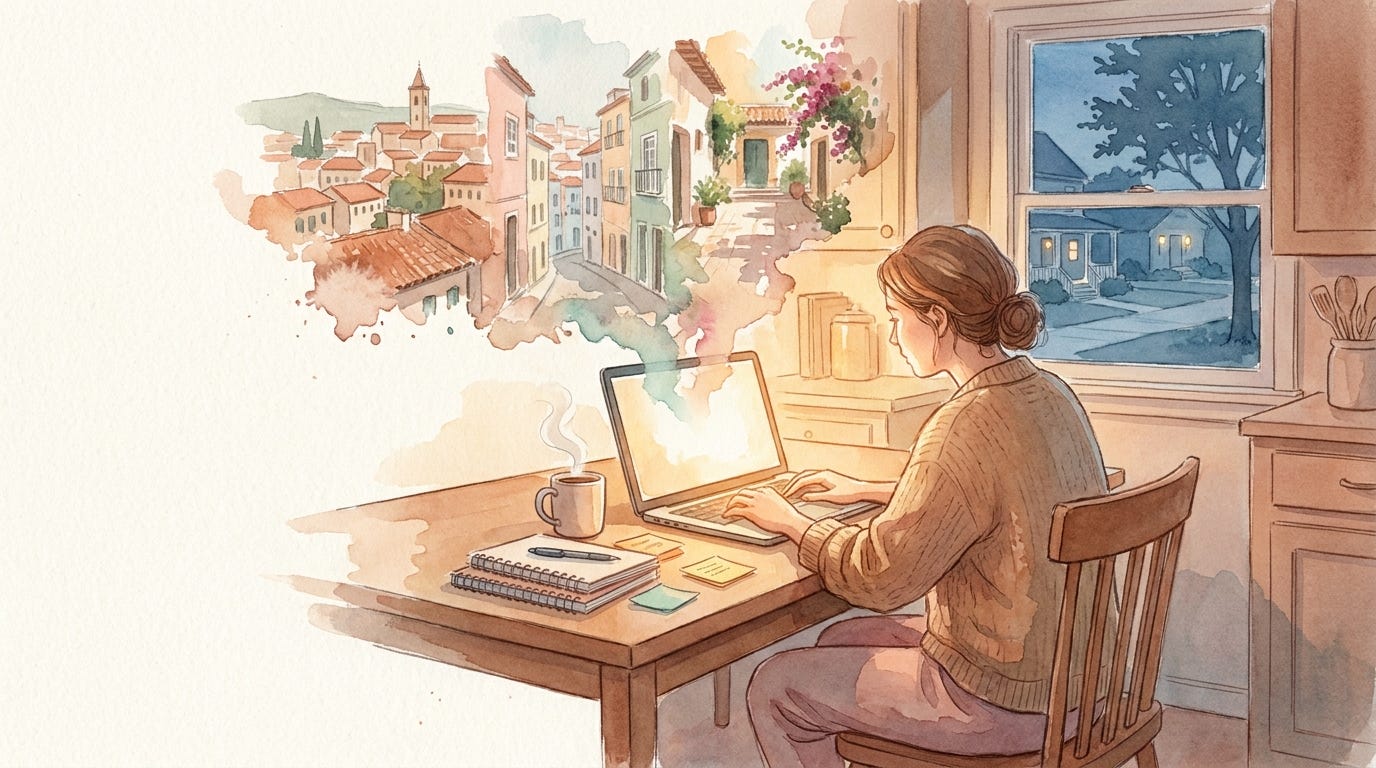
There are conferences now.
Full-weekend events, selling out across the United States, with ticket prices between $500 and $1,000 — dedicated entirely to teaching Americans how to leave.
In 2025, more Americans left the country than moved in. For the first time in 90 years.¹ At least 180,000 US citizens emigrated — the largest outbound migration in decades.² The Brookings Institution expects even more are leaving in 2026.
And it goes far beyond America. Brits are leaving. Australians too. Canadians making their own calculations. People in countries that were supposed to be stable are making backup plans, asking their own version of the same question: what if I stayed, and what if I regret it?
It’s happening everywhere. After the kids are in bed, they’re running the numbers. Comparing the cost of living in Spain versus Portugal. Watching tours of neighbourhoods they’ve never heard of.
I’ve been living abroad for 20 years — mostly in Thailand, with a move to Spain coming in a matter of months. I am doing this myself, right now, for the second time in my adult life.
So before you book anything — before the visa research and the cost of living spreadsheets and the Reddit threads — sit with these 5 questions first. The questions themselves will tell you more than any conference, any YouTube tour of a neighbourhood in Lisbon or Valencia or Mexico City ever could.
Here’s what I wish someone had handed me before I left.
You Will Not Break; You Will Stretch
There I was, finally living by the beach. It was the height of COVID, and I’d scored an affordable, well-built, spacious bungalow just steps from the ocean — my first time living beachside since moving to the island six years earlier.
But it didn’t feel like a reward. It felt like a consolation prize.
I wasn’t soothed by the waves lapping at the shore — I was taunted by them. I wasn’t sitting back with my feet up contemplating life — my head was in my hands as tears poured out of me until I had nothing left. I was surrounded by paradise, but rather than thriving, I was drowning.
I’d left our family home when I couldn’t take any more of the fights. Fraser and I had just come back to our home on Koh Phangan with our 6-month-old, and we were falling apart.
My father had just died after a brutal, two-year battle with cancer. My mom had remarried a man I couldn’t stand. All in Mexico, all a long way from where I was in Thailand.
My business — the one I’d poured years of my life into — was on the brink of collapse. Contracts were cancelled. Clients ghosted. The bills kept coming, but the money didn’t.
I was holding it all together… barely. And then I wasn’t.
Six months. That’s how long I sat in that bungalow, waiting for someone — anyone — to check on me.
And I remember in that moment feeling so desperately unimportant to the world. I’d uprooted myself from everything I knew, and now my entire safety net had dissolved before my eyes. I looked longingly at the powerful ocean and wondered:
Would anyone really care if I tied some heavy rocks to my feet and took a long walk into the ocean?
But here’s the thing about being forgotten like that: it forces you to remember yourself.
Because leaving isn’t just packing bags and booking flights. It’s grief.
The slow, creeping kind that arrives in bits and pieces. It hits you in unexpected moments when you least expect it.
It’s the moment you’re scrolling through Instagram and see your friends back home out together. You weren’t invited — not because they forgot you, but because you’re not there anymore.
It’s the moment your best friend calls you after she’s had a baby and says, “I wish you were here.”
It’s realising that for the people back home, out of sight really does mean out of mind.
It’s knowing that nobody really likes video calls — not even the people who insist they do.
I know this pain because I’ve felt it.
So yeah, there will be extreme moments of loneliness. You will miss people. You will miss moments. You will grieve your old life and sometimes wonder if you made a mistake.
But you will not break. You will stretch.
I know it sounds like I’m trying to spin it, but I’m not. Stretching hurts. It hurts like hell. It feels like you’re being pulled in two directions at once.
But that stretch gives you the capacity to hold more joy, more strength, and more life than you ever thought possible.
People Are Leaving — In Numbers We Haven’t Seen in Decades
42% of all Americans have considered moving abroad in the next two years.³ Among Gen Z, that number climbs to 63%. Among women aged 15 to 44, it has reached 40% — four times higher than a decade ago.
The US passport has lost ground. In 2021 it ranked first globally for travel freedom. By 2025 it had fallen to 14th.⁴
And it goes far beyond America’s borders.
South Korea has seen a 4,000% increase in foreign residents over the past 30 years.⁵ The Netherlands has had such a surge in immigration that its government has declared itself “full.”⁶ In Israel, political instability has driven unprecedented numbers of people to leave since 2022.⁷ The war in Ukraine has displaced 6.8 million people, with another four million internally displaced.⁸
This is a movement. And if you’re in it, you’re in good company.
The Big Question — Should You Leave?
If you’re still here, reading this, then you already know the question.
It’s not “What if I left?” — it’s “What if I don’t?”
And that question will haunt you. It will keep you up at night, staring at the ceiling, wondering if you’re slowly suffocating in a life that used to fit but now feels too tight.
The truth is, I can’t answer that question for you. No one can. This is one of those times in life where you have to get brutally honest with yourself. Are you running away from something? Or are you running toward something?
I know, I know. You’ve heard that line before. It’s become a self-help cliché. But here’s the thing: sometimes you do need to run away. Sometimes you need to walk, jog, sprint, and fly away from whatever is suffocating you. There’s no shame in that.
But the only person who can answer this is you. So here’s a framework to help you figure it out.
5 Questions to Ask Yourself Before You Leave
These questions aren’t cute. They aren’t easy. But if you answer them honestly, you’ll know what to do next.
1. If you stay exactly where you are right now, how will you feel three years from now?
The real version of your life — same job, same salary, same stress, same surroundings. No filter.
Are you okay with that? If yes, then maybe it’s not time to leave. If the answer is “Absolutely not,” then maybe that’s your sign.
I think about my friend Allie , who asked herself this exact question. She was living in the US, feeling restless and worn down, and she could see her future stretching out in front of her like a straight, endless road. Same job. Same commute. Same days on repeat. She knew, deep down, she couldn’t do it for three more years. So she left. First to Bangkok, then to India, then to London, and now she’s raising her kids in a fancy flat in Amsterdam with a husband she met along the way.
Her life didn’t just change — it expanded.
2. Are you craving something new, or are you craving freedom?
Be honest. Are you hoping for palm trees and pretty sunsets? Or are you hoping for space to breathe? The two aren’t the same.
Newness wears off. Freedom lasts.
I used to think I was craving newness. I thought living abroad would be a postcard-perfect montage of sea breezes and golden sunsets. But after 15 years living on a tropical island, I know that what I was actually craving was freedom from the script I’d been handed — the “get the degree, get the job, get the house, get the retirement plan” script. That script wasn’t for me. I wanted to feel like I had control over my own life.
My friend Juliette found the same thing. She left France with two toddlers and a partner. She raised them on a Thai island, navigated setbacks that would have crushed most people, and built a life where she calls the shots. She left for agency.
Are you chasing novelty? Or are you chasing freedom?
3. Are you more afraid of change, or more afraid of staying the same?
Staying is comfortable. It’s familiar. You know how it goes. Leaving is the leap.
Fear of change will keep you stuck. Fear of staying stuck will change your whole life.
I’ve been afraid of both, honestly. I was afraid of changing everything I knew. But I was more afraid of waking up one day and realising I’d done my whole life wrong.
When my friend Megan moved to Bali with her child, I asked her if she was scared. Her answer has stayed with me for years. She said, “Of course I was scared. But I was more scared of waking up one day and realising I’d lived a life that belonged to someone else.”
4. What’s the absolute worst-case scenario if you leave?
Play it all the way out. Say it all goes wrong. The visa falls through. The job disappears. The dream crumbles.
Where do you end up? On your mom’s couch for three months? Applying for jobs back home? Back where you started?
You’ve survived worse, haven’t you? If that’s the worst that could happen, is it really that bad?
My husband left Scotland at 21. No high school diploma. No degree. No fancy resume. He just left. If it all went wrong, he’d go back to Scotland, where all his friends and family were.
It didn’t go wrong. It went spectacularly, brilliantly right. He built a construction business on Koh Phangan from nothing — no diploma, no safety net, no plan B.
He knew that if he failed, he’d survive. So he jumped.
If you think of failure that way — as a slight detour rather than the end of the road — it becomes a lot less scary.
5. What if it all goes right?
This is the question nobody asks themselves. We’re so good at imagining failure.
But what if it works? What if the visa comes through? What if you wake up in that sunlit apartment, sipping a cup of coffee, and you feel calm for the first time in years? What if your life feels bigger than you imagined it could be?
You’ve been so busy preparing for worst-case scenarios. Take a second to imagine the best-case one.
What would that look like?
(Go ahead. Close your eyes. Picture it.)
The People Who Leave (And Why They Don’t Regret It)
There will be people who try to warn you, “Don’t do it, you’ll regret it,” or “What if you hate it?”
Here’s something I’ve noticed after 20 years of living abroad.
The people who leave never say they regret it.
You know what they say instead?
“I can’t believe I didn’t do this sooner.”
“Even if I go back home, I’ll be different now.”
“I had to leave to realise how strong I am.”
I think about my mom, who moved to Mexico over a decade ago. She endured a shocking amount of bureaucracy and red tape. She watched her husband lose his battle with cancer there. She remarried there. When she got sick herself — cancer, chemo, the full weight of it — she stayed. She was in Mexico when she died, at 77.
Through all of it, through all the years and all the hard things, she never spoke ill of that country. She never expressed a single regret about going. She thought of Mexico as her home, and she was grateful for it until the very end.
Some people leave, stretch, and then go back. That’s okay too. But they are never the same.
The Truth You Already Know
What you’ll find here at Home Abroad is the truth. The real version, with nothing curated out of it. Because what you’re actually looking for is alignment — and that’s a different thing entirely from easy.
You don’t need anyone to give you permission. But in case you’re waiting for it, here it is:
Go. Do it. You already know the answer.
Because the deeper the stretch, the more life you can hold.
I’m sitting with these five questions myself right now. Twenty years in. About to move again. The answers don’t get easier. But they do get clearer.
Got something to say about all this?
I’ll be waiting to hear from you down in the comments!
Footnotes
¹ Brookings Institution, cited in The Wall Street Journal, 2026. https://www.yahoo.com/news/articles/first-time-90-years-more-201700554.html
² Global Citizen Solutions / Pew Research Center, cited in The Boston Globe, May 2026. https://www.bostonglobe.com/2026/05/12/lifestyle/record-number-of-americans-leaving-us/
³ Gallup/Monmouth composite survey, 2025. https://getwherenext.com/blog/amerexit-by-the-numbers
⁴ Global Citizen Solutions Global Passport Index, 2025. https://www.inman.com/2026/05/12/more-americans-moving-abroad-expats/
⁵ NY Post, September 2024 — South Korea foreign residents data.
⁶ The Times — Netherlands immigration statement.
⁷ Jerusalem Post, 2024 — Israel emigration figures.
⁸ UNHCR — Ukraine displacement figures, 2024.
These numbers are eye popping! I knew moving abroad had become a hotter topic lately, but had no idea it was at this level.
I love your question number 5. When I was deciding my last move I was so stuck on number 4, coming up with contingency plans B,C,D… and thinking of everything that could possibly go wrong. Then a friend said “but what if things go even better than you planned?” and it was genuinely the first time I had ever thought of that.
I just wrote about this last week because clearly it’s a hot topic. But I think it goes much deeper than who you become if you stay versus who you become if you leave. The real question is whether you’re prepared for the version of yourself waiting on the other side of the move.
A lot of people psych themselves up for moving abroad. They romanticize it. Glorify it. Build an entire fantasy around fresh markets, slower mornings, beautiful architecture, and escaping the chaos. And honestly? A lot of that part is true.
But what people prepare for far less deeply is who they become once the novelty wears off and real life settles in.
Especially if you’re retiring abroad.
Are you prepared for doing “nothing” to suddenly become your full-time something?
Are you prepared to lose the identity your career gave you?
Are you prepared to be unknown again? To not feel important? To not automatically understand how things work? To not constantly be stimulated by the hustle you spent decades complaining about?
The list goes on and on.
Living abroad sounds trendy. And for me, it’s been wonderful. I love my life in France. But if I’m being honest, it’s not France that changed me most. It’s my personality that changed here.
I would have become a very different person had I stayed in the United States. Both versions of me probably survive. But one path is unquestionably easier.
And it’s not the moving abroad one.